
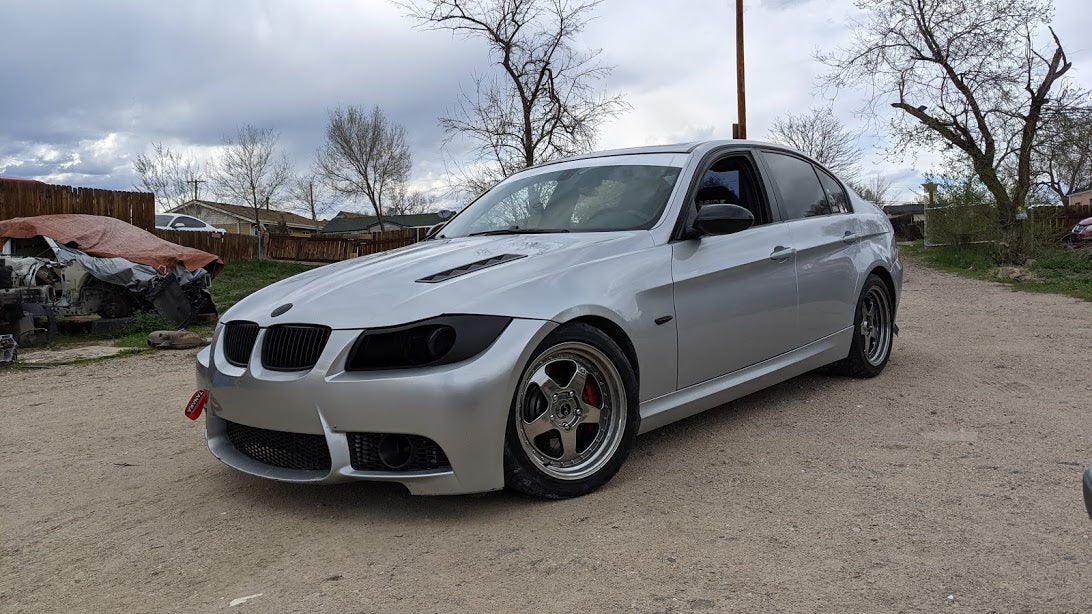
2006 BMW E90 325i, N52 with ZF 6-speed automatic. Custom Eaton M90 Roots-type supercharger from a 1991 Ford Thunderbird Super Coupe, stock N54 front-mount intercooler, N54 intake manifold, S65 (E90 M3) injectors, Turbosmart bypass valve, catless exhaust, 91 octane. About 3,000 lb and daily driven with AC. Never dynoed; estimated around 300 whp at Denver altitude.
Most supercharged N52s run a bolt-on centrifugal kit. This one didn't. It was a one-off build around an Eaton M90 Roots-type blower pulled from a 1991 Ford Thunderbird Super Coupe, plumbed through a factory N54 intercooler into an N54 intake manifold, on an E90 that was driven every day. The car and the M90 setup are gone now, but here's every part that was on it, how the air got from the headlight to the cylinders, what went wrong along the way and how it was fixed, and why we wouldn't build it this way again.

The supercharger: an Eaton M90 from a Thunderbird
The heart of the build was an Eaton M90, the Roots-style supercharger Ford used on the 1989–1995 Thunderbird Super Coupe. Unlike a centrifugal blower, a Roots blower makes boost almost immediately off idle, so the torque comes in low and stays flat. It sat right under the hood, roughly where the factory intake used to be, and was driven by an extra loop on the accessory belt.


- Blower: Eaton M90 Roots-type, from a 1991 Thunderbird Super Coupe
- Intake manifold: N54 intake manifold, which is essentially a direct bolt-on to the N52
- Inlet: a cut-up intake adapted to feed the blower, with the factory MAF and throttle body still in the path
- Outlet: a custom adapter plate with a welded pipe that ran to the intercooler
- Belt: an off-the-shelf belt from Advance Auto Parts, found by test-fitting a few lengths. The other accessories kept their stock routing, and the belt came up and over the supercharger pulley

Fabricating it
Everything between the blower and the engine was made by hand: the outlet was measured for the adapter plate, the M90 was test-fit on the N54 intake manifold, the charge pipe was welded up to run under the blower, the N54 intercooler went in behind the bumper, and the headlight intake duct was made from scratch.


The air path, start to finish
- Air was pulled in through a custom intake behind the driver-side headlight
- It passed through the factory MAF sensor
- Then the throttle body, which on an N52 stays almost fully open because Valvetronic (variable valve lift) controls engine load, not the throttle
- Into the M90, where it was compressed
- Out through the adapter plate and a welded pipe that ran underneath the blower
- Through a stock N54 front-mount intercooler
- Back up and over the radiator, along the bottom of the supercharger and into the N54 intake manifold
Fitting the intercooler meant swapping in an N54 radiator and fan for clearance. The charge pipe that ran over the radiator was wrapped in gold reflective heat tape so it wouldn't soak up radiator heat.

Hear it: engine bay revs
The M90's whine is the giveaway, even at idle:
And revving with the hood up:
Cooling: intercooler, coolers and hood vents
A Roots blower makes a lot of heat, so most of the work beyond the blower itself went into getting heat out.

- Intercooler: stock N54 front-mount, later upgraded to a VRSF 5" front-mount. For a bolt-in upgrade, see the 335i 5" FMIC or the larger ARM 1K 7.5" FMIC kit
- Transmission cooling: a large Burger Motorsports transmission cooler up front
- Engine oil cooling: an OEM N54 engine oil cooler tucked into the fender liner, because oil runs hotter under boost
- Hood vents: one vent directly above the supercharger to let blower heat escape, plus a matching vent on the other side
- Headlight intake: the transmission cooler took over the lower duct the car used before the supercharger, so the intake drew air from behind the driver-side headlight instead
- Heat management: all sound deadening at the back of the engine bay was removed, and the transmission tunnel insulation was cut back for better heat dispersion (and about 6 lb saved). The charge piping was coated in high-temp paint and wrapped in gold reflective heat tape to keep heat inside the pipes


Fuel, ignition and sensors
- Fuel: 91 octane pump gas
- Injectors: stock OEM E90 M3 (S65) injectors, the same ones ESS uses in its N52 supercharger kit. E85 would have needed bigger injectors
- Coil packs: N54 Eldor coils. Of the Bosch, Delphi and Eldor OEM coils, Eldor have been the most reliable in my N54 experience, with no misfires even at high boost. They plugged straight into this 2006 N52 with no issues (later N52s may differ). Under boost, gap the plugs down; a spark plug gap tool makes it quick
- Wideband: AEM wideband in the secondary O2 sensor location, wired to a gauge in the cabin
- Boost reference: a brass T-fitting on the intake manifold feeding an AEM boost gauge
- Intake air temp: a fast-reading GM intake air temperature sensor in a welded bung on the post-supercharger piping (more on why below)
Crankcase ventilation
The factory CCV (crankcase ventilation) system under the intake manifold was deleted. The valve cover's rear port ran to a catch can (a Burger Motorsports-style replica that worked fine), and the catch can was teed into the EVAP purge line that fed the throttle body. Because the N52 makes almost no manifold vacuum thanks to Valvetronic, crankcase pressure under boost was something we kept a close eye on.
Problems and fixes
The initial build took three full days and nights, working until 3 a.m., and a few revisions followed to chase down leaks. A one-off kit means solving problems nobody has written up yet. The big ones:

| Problem | Fix |
|---|---|
| Boost leaking at the blower outlet adapter plate | Had a much thicker adapter plate made and sealed it to the supercharger with a Teflon gasket plus RTV. No more leaks |
| IAT readings heat-soaked by the blower (Turner Motorsport IAT relocation in the manifold) | Welded a bung into the post-supercharger piping for a GM IAT sensor, which reads much faster and measures the air after compression, not before |
| Pressure building between the blower and the closed-off intake when lifting off throttle | Added a Turbosmart bypass valve, recirculated after the throttle body back into the supercharger inlet. This kept intake temps and blower temps down. The Turbosmart RacePort BOV (Low Vacuum) suits low-vacuum supercharged cars, or get the complete N52 / N51 Turbosmart BOV kit |
| Under-hood heat | Twin hood vents, high-temp paint and gold heat wrap on the piping, and the engine bay insulation removed |
| Crank hub spun and the crank bolt backed out | The extra belt load from the M90 eventually spun the crank hub and backed out the crank bolt. This is the biggest risk of belt-driven boost on an N52 without a pinned or upgraded crank hub. See our N52 common problems guide for other weak points to check first |
| Rear riding much higher than the front after gutting the interior | Fitted KW V1 springs with adjustable perches and removed the thick front strut reinforcement plates (about 8 mm lower) for a level stance |
Why move the IAT sensor? The stock intake air temperature sensor lives in the MAF, before the supercharger. Air coming out of a Roots blower is far hotter than what goes in, so the tune needs a sensor after compression, and a GM sensor responds much faster than the factory one.
Transmission and tuning
The car kept its ZF 6-speed automatic (6HP), running an xHP Stage 3 flash for faster, firmer shifts. The shifter in the cabin just looked like a manual.
The engine ran a custom remote tune that went through several revisions, each one smoother and stronger than the last. The target was about 350 whp, but the tune was never pushed aggressively and the car only ever ran 91 octane. It was never put on a dyno; our best estimate is around 300 whp at Denver altitude.
With the Roots blower making boost right off idle, launches were where it felt strongest:
It also ran a 2-step (launch control) through a WOT box:
Brakes, wheels and suspension
Brakes
- Front: N54 (335i) calipers, a bolt-on upgrade over the much smaller 328i/325i units, with drilled and slotted rotors
- Rear: a 15-inch-wheel-compatible conversion using 328i calipers with smaller rotors, so the car could run almost any wheel size at the drag strip. Both front and rear calipers were painted candy apple red
- E-brake: deleted, since it didn't fit with the 15-inch conversion


Wheels
The car ran three-piece five-spoke wheels up front and Enkei RPF1s in the rear. A wheel stud conversion (like our 12x1.5 race stud conversion kit with race lug nuts) made wheel swaps faster and meant no different bolt lengths for every spacer. The studs were good up to 25 mm spacers; it ran 12 mm in the rear and 20–25 mm up front.


Suspension
- Shocks: adjustable Koni Yellows to improve 60-foot times and launches
- Springs: Eibach Pro Kit, plus KW V1 springs with adjustable spring perches to level the car
- Stance: thick front strut reinforcement plates removed, lowering the front about 8 mm
- Differential: a heavy-duty diff brace from VWTish

Interior and weight
The interior was fully gutted: factory seats, carpet, sound deadening, rear speakers and trunk trim all came out. With the cabin stripped to bare metal, the floor and rear seat area were painted with white appliance paint. It's cheap, tough and easy to clean, and it makes a gutted interior look finished instead of half-done.


The car weighed about 3,000 lb (just under 3,100 lb with some trunk carpet back in), and it kept working AC, heat, the front sound system and the windshield washer.
- Two Bride bucket seats on Sparco seat brackets with VAC floor mounts, which have a ton of adjustability
- Carpet, rear seats, rear speakers and trunk trim removed for weight, with the bare floor painted white
- Instrument cluster: white LED swap, E90 M3 gauge rings and red needles, and an N54 cluster coded with Perfect Toolbox to show oil temperature
- AEM wideband and boost gauges in an eBay vent pod (gauges from Colorado N5X), plus a phone running ProTool for extra live data
Exhaust
The exhaust was catless, with replica (AA-style) long-tube headers that ran about 6,000 miles without issues. It was very loud with just a Vibrant muffler, so it got the largest Vibrant 3" bottle-style resonator and the largest Vibrant "fart can" muffler, which evened out the tone and killed the raspy notes.


Here's what it sounded like from outside the car:
For more N52 exhaust ideas, see our N52 exhaust guide with 16 real setups.

Lessons learned: would we build it again?


No, and we wouldn't recommend replicating it. It was a fun, budget way to get boost on an N52, but:
- Labor: three days and nights to build, plus revisions to fix leaks, and a lot of custom fabrication
- Crank hub: it eventually spun the crank hub and backed out the crank bolt
- Heat: the M90 is an old Roots design that runs hot, which meant constant work on intake temps and under-hood heat
- Weight and packaging: it's heavy and takes up a lot of space in the engine bay
Modern centrifugal kits are lighter, run cooler, bolt on, and come with proven tunes and support.
Want boost without the headaches? The 22RPD N52 supercharger kit is the bolt-on route (already running an ESS kit? see the ESS supercharger upgrade kit), and our 500WHP N52 guide walks through every stage. For a different take on a supercharged N52, see Raimund's 330i build.
Frequently asked questions
Can you put an Eaton M90 supercharger on a BMW N52?
It can be done, but there's no off-the-shelf kit, and we don't recommend it. This build used an M90 from a 1991 Thunderbird Super Coupe with a custom inlet, a custom outlet adapter plate and piping, a stock N54 intercooler and an N54 intake manifold, which bolts almost directly onto the N52.
Does the N52 intake manifold need to change for a supercharger?
On this build, yes: the factory 3-stage manifold was replaced with an N54 intake manifold, which is essentially a direct bolt-on to the N52 and makes it much easier to route the boosted charge pipe.
What injectors does a supercharged N52 need?
This car ran stock E90 M3 (S65) injectors, the same ones ESS uses in its N52 supercharger kit. Larger injectors are needed if you want to run E85.
Why use a bypass valve on a Roots supercharger?
When you lift off the throttle, pressure builds between the blower and the engine. A bypass valve (here a Turbosmart unit recirculated back to the blower inlet) relieves it, which keeps intake air and supercharger temperatures down.
Where should the intake air temperature sensor go on a supercharged N52?
After the supercharger. The stock sensor is in the MAF, before compression, so it reads far cooler than the air actually entering the engine. This build used a fast-reading GM IAT sensor in a welded bung on the post-supercharger piping.
How much power did the M90 N52 make?
It was never dynoed. The target was about 350 whp, but on a conservative tune and 91 octane, our best estimate is around 300 whp at Denver altitude.
Would you recommend an Eaton M90 swap on an N52?
No. It took three full days to build plus revisions for leaks, eventually spun the crank hub and backed out the crank bolt, and the M90 is an old design that runs hot, is heavy and takes up a lot of space. A modern bolt-on centrifugal kit is the better route.